Types of Axes Explained: Viking, Throwing, Camp and Felling
An axe is a wedge on a stick, and almost every difference between one axe and another comes down to three things: how heavy the head is, how wide the wedge is, and how long the handle is.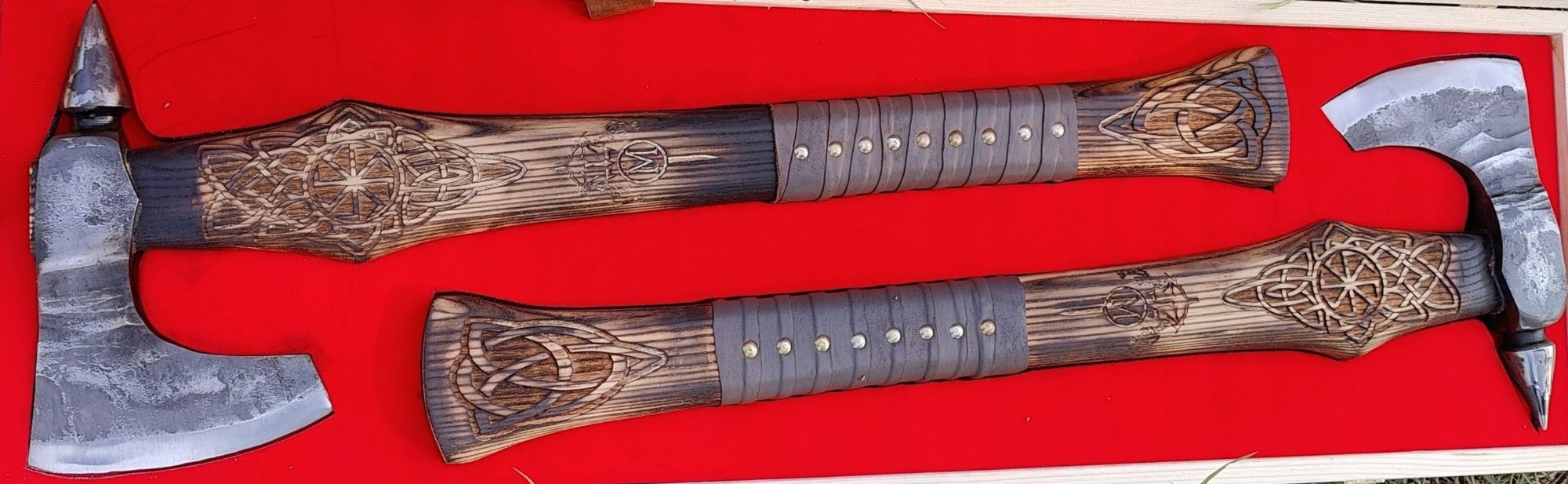
A felling axe has a thin wedge because it cuts across wood fibres. A splitting axe has a fat wedge because it forces fibres apart. A throwing axe is light because it has to fly straight. A Viking axe has its weight pulled back towards the handle because it was made to be swung at something that moved.
This guide covers the main types of axes, what each one is actually for, and what to look for when buying one.
Viking and bearded axes
The bearded axe is the shape the Norse settled on and never really improved.
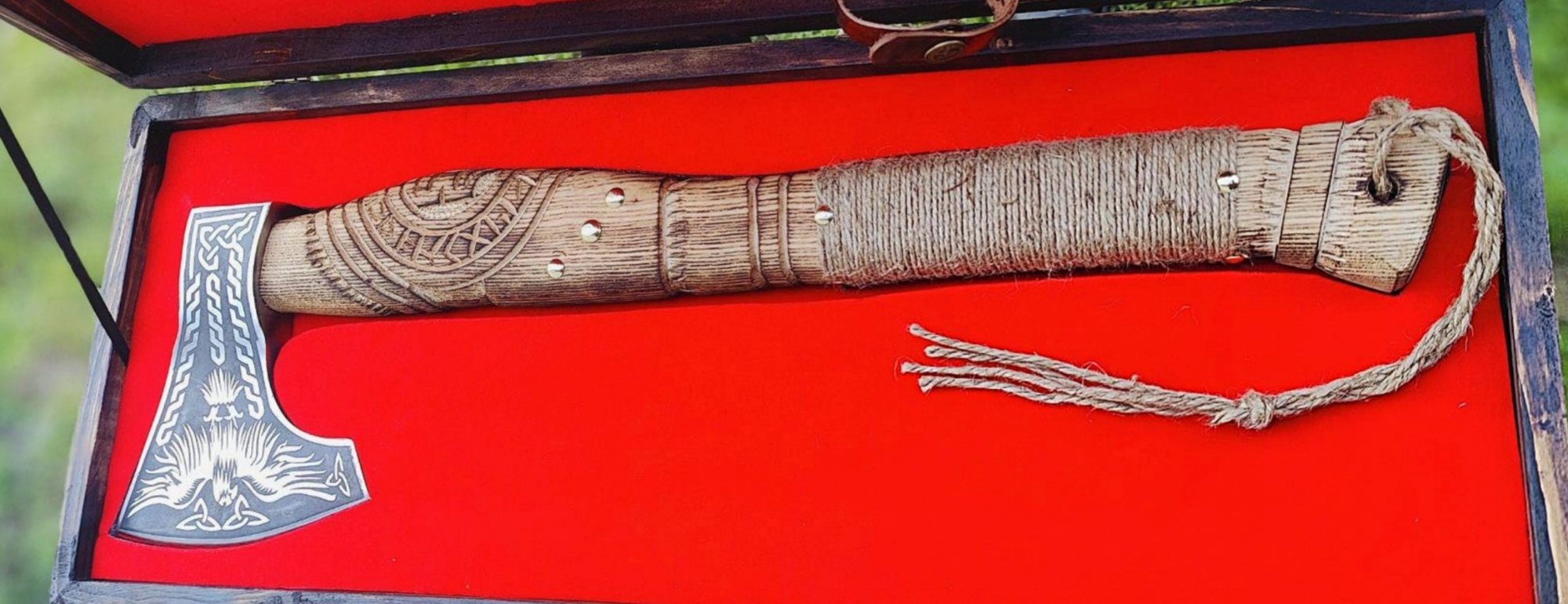
The lower edge of the head sweeps down and back into a beard, dropping well below the eye where the handle passes through. That buys two things. First, a long cutting edge without the weight of a solid head, because the beard is steel where you need it and air where you do not. Second, a gap behind the blade where you can grip up close for carving and fine work, then slide your hand back down the handle for a full swing.
Viking axes were working tools as much as weapons. The same axe split firewood, shaped boat timbers and went to war, which is why they are light compared to a modern felling axe.
Today most Viking axes are bought for display, collections and re-enactment. The lighter ones are genuinely usable for kindling and camp work. The heavily decorated ones, with etched runes and carved handles, are made to be looked at.
Throwing axes
A throwing axe is built around one requirement: it has to rotate predictably.
That means it is light, usually under 2 lb in the head, and the weight is kept close to the edge rather than spread back through the eye. The handle is straight, because a curved handle leaves the hand at a different angle every time. The edge is ground thin and the cheeks behind it are flat, so it bites into a board instead of bouncing off it.
Throwing axes are not camp axes that happen to be thrown. A felling axe thrown at a target will usually glance off, and the handle will take the damage. If you want to throw, buy a throwing axe.
Most people buy them in pairs, because at a target you throw one, then the other, then walk up and collect both.
Tomahawks
The tomahawk is the North American shape, and it is the lightest working axe in common use.
The head is small and the eye is tapered, wider at the top than the bottom, so the head slides on from below and wedges tight under its own use. Nothing holds it but friction and the taper, which means a tomahawk head can be knocked off and replaced in the field with a handle you cut yourself. That is the whole design, and it is why the shape survived.
A tomahawk is a general camp tool: it chops, it throws, it drives tent pegs with the poll, and some carry a spike or a hammer face on the back. It will not fell a tree and is not meant to.
Camp and bushcraft axes
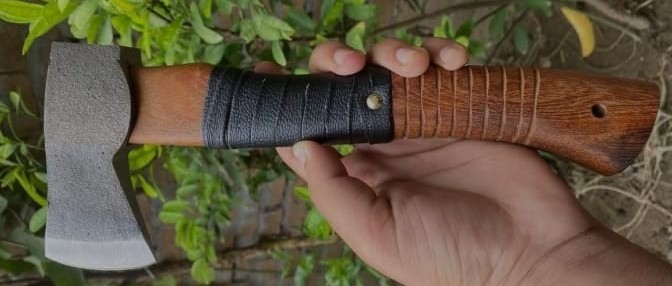
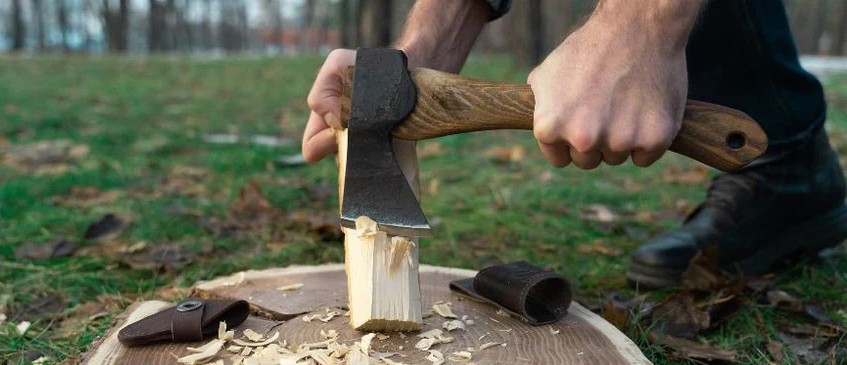
A camp axe sits between a hatchet and a felling axe, with a handle around 18 to 24 inches.
That length is the compromise everything else follows from. Long enough to swing two-handed and get real force into a log, short enough to choke up on and carve with one hand, and short enough to strap to a pack without catching on branches.
The head is usually 1.5 to 2 lb with a fairly thin bit, because a camp axe cuts more than it splits. A flat poll on the back is worth having: it drives tent pegs and wedges without you reaching for a mallet.
If you camp and do not know which axe to buy, buy this one.
Hatchets
A hatchet is a one-handed axe, usually a 12 to 16 inch handle and a head around 1 to 1.25 lb.
It is a kindling and kitchen-of-the-woods tool. It splits small rounds, limbs branches, points stakes and does the hundred small jobs around a fire that a big axe is clumsy for. Carried on a belt rather than a pack.
The limitation is reach. A hatchet makes you work close to the wood, which is where accidents happen, so a hatchet wants more care than its size suggests. Split on a chopping block, never on the ground and never holding the piece with your other hand.
Felling axes
A felling axe cuts across the grain, and everything about it follows from that.
The bit is thin and the cheeks behind it are slim, so the head slices into the fibres rather than wedging them apart. The handle is long, 28 to 36 inches, because the speed at the head is what does the cutting and a longer handle swings faster at the edge. Head weight is usually 3 to 4 lb.
Used on a standing tree you cut a wedge out of one side and a second cut from the other, and the tree falls towards the first. It is skilled work and it is the one axe job where being wrong is genuinely dangerous.
A felling axe is a poor splitter. Thrown at a round of wood it buries itself in the end grain and sticks.
Splitting axes and mauls
A splitting axe does the opposite job: it drives into end grain and forces the fibres apart.
The bit is thick and the cheeks flare out sharply behind the edge, so the head acts as a wedge and pops the round open before it can bury itself. Heads run 4 to 6 lb, and a maul, which is a splitting head with a sledge face on the back, can go to 8 lb or more.
Sharpness matters far less here than weight and shape. A splitting axe works by force, and a very sharp splitter mostly just sticks.
If you heat with wood you want a splitter. If you clear fallen timber you want a felling axe. Buying one to do both means doing both badly.
A word on handles
The handle fails long before the head does, so it is worth more attention than it usually gets.
Ash and hickory are the traditional woods because they bend rather than snap and they absorb shock instead of passing it into your hands. The grain should run along the length of the handle, not across it, and you can see this on the end of the haft: the lines should run roughly parallel to the blade, not at right angles to it.
A leather wrap on the lower third is grip, not decoration. Wet hands and a 4 lb head are a bad combination.
Synthetic handles do not break and do not care about weather. They also transmit more shock, and they cannot be replaced with a branch and a knife.
A word on steel
Axe steel has an easier job than knife steel, because an axe edge is thick and supported, and it is not asked to slice.
What matters is that the edge is hard enough to hold a shape through a day of work and soft enough not to chip when it hits a knot or a stone. Most axe heads are high carbon steel, and most are hardened only at the bit, leaving the body of the head tougher.
Damascus axe heads exist and are forged from layered steel in the same way Damascus blades are. On an axe the pattern is display more than function, because the working edge is a tiny part of the head.
Stainless steels like 12Cr are used where the axe will be handled, photographed and hung on a wall rather than left in a damp shed.
How to choose
Start with the job, not the look.
If you camp and want one axe, buy a camp axe with a handle around 20 inches. It is the only size that does most things acceptably.
If you split firewood at home, buy a splitting axe or a maul. Nothing else is close.
If you fell or limb standing timber, buy a felling axe with a 30 inch handle, and learn to use it before you need it.
If you want to throw, buy a purpose-made throwing axe, and buy two.
If you are buying for display, for a collection or as a gift, the rules change entirely. A bearded Viking axe with runes on the head and a carved handle is doing exactly what it was bought to do when it hangs on a wall. Buy the one you want to look at.