What Is Hand Forging? How a Forged Blade Is Actually Made
Hand forging means heating steel until it is soft enough to move, then shaping it with a hammer. That is the whole definition. Everything else people argue about comes down to how much of the work is done that way, and how much is done by cutting metal away instead.
Forging versus stock removal
There are two ways to make a knife blade.
In stock removal, you start with a flat bar of steel, cut the blade shape out of it, and grind away everything that is not the knife. The blade is then heat treated the same way a forged one is: brought up to temperature, quenched, and tempered, so it holds hardness and takes an edge. The steel is never heated in order to move it. Most factory knives are made this way, and plenty of excellent custom knives are too. It is a legitimate method, not a shortcut.
In forging, you start with a lump or bar of steel and heat it in a fire until it glows. At that temperature the steel behaves almost like clay. You hit it, and it moves. You keep heating and hitting until it is roughly the shape you want, and only then do you start grinding.
The difference is not which one is better. It is that forging lets you do things stock removal cannot, and Damascus is the clearest example.
How Damascus is actually made
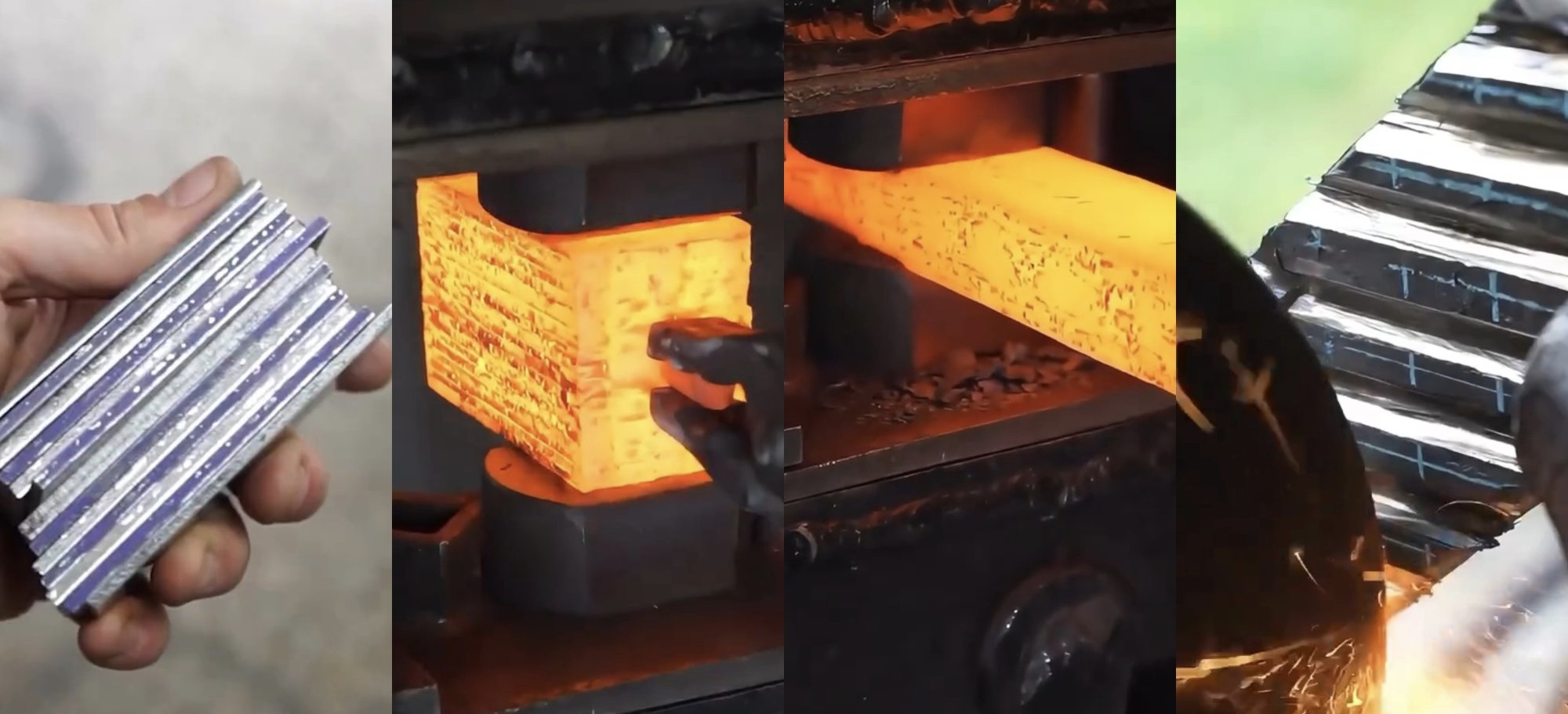
Damascus steel is not one steel. It is two or more different steels welded together into a single piece.
You stack alternating layers of steel, heat the stack until the surfaces are near molten, and hammer them together until they fuse. That is a forge weld. Then you draw the billet out, fold it back on itself, and weld it again. Every fold doubles the layer count. A billet folded ten times carries hundreds of layers.
The pattern you see on a finished Damascus blade is those layers, cut through at an angle by the grinding and then brought out with acid. The two steels etch at different rates, so one goes dark and the other stays bright. The pattern is not printed on the surface. It runs all the way through the steel, which is why you can sharpen a Damascus blade for years and the pattern never wears off.
There is no way to do this without forging. You cannot cut layered steel out of a flat bar, because nobody sells flat bar with those layers in it. The layers have to be made, and making them means hammer and fire.
Does the hammer have to be swung by hand?
This is where the term gets argued about.
A power hammer is a machine that lifts a heavy weight and drops it on the steel, over and over, while the smith holds and turns the piece underneath it. The smith decides where every blow lands, at what angle, and when to stop. The machine supplies the force. The hands supply the judgement.
Almost every working bladesmith uses one, because forge welding a billet by arm alone takes hours and the steel cools faster than you can work it. Swinging a hand hammer for everything is possible, and some smiths do it for small pieces, but it is a choice about tradition rather than a measure of quality.
So when we say hand forged, we mean the steel was heated and hammered into shape with a person controlling every stage of it. We do not mean the blade was shaped in a press by a machine nobody was watching.
How we make ours
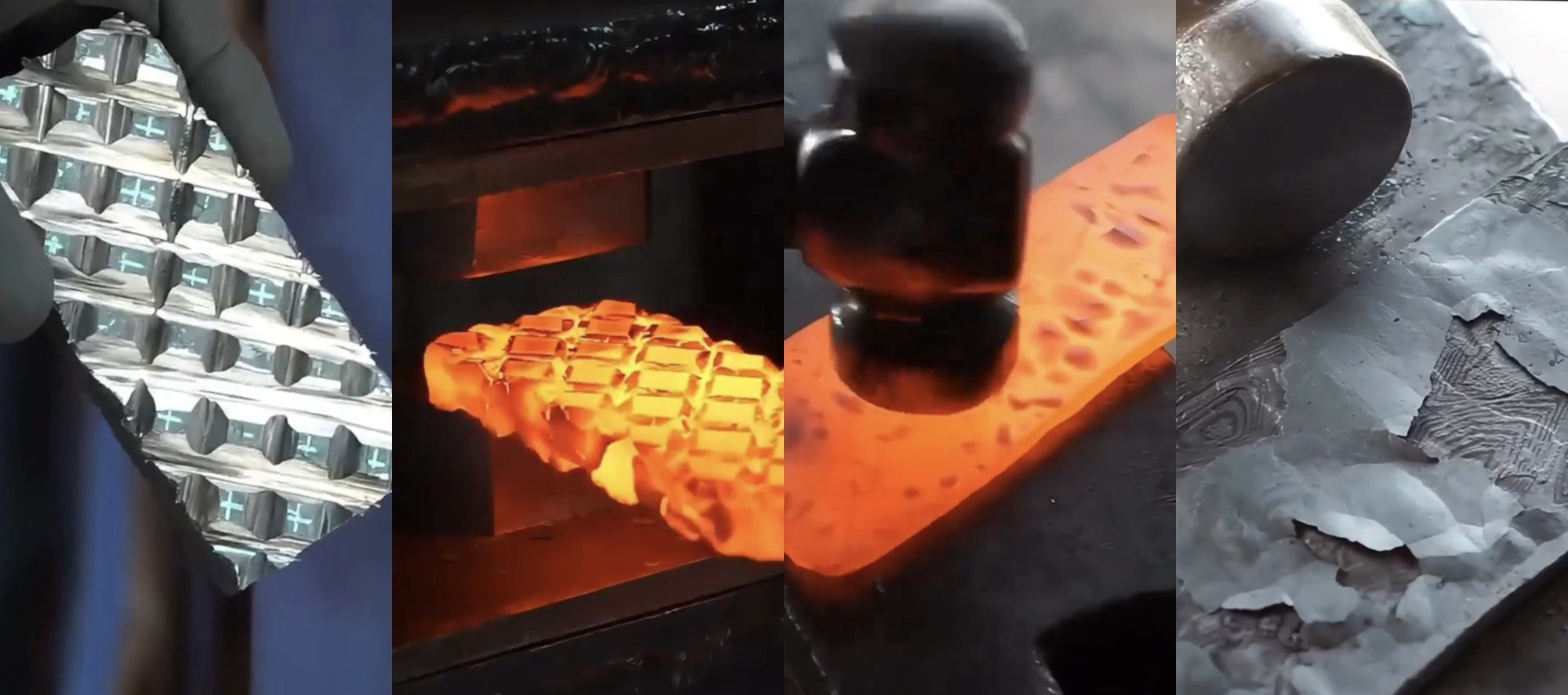
Our Damascus blades start as stacked steel. We heat the stack, hammer it from every side, fold and weld the layers, and repeat until the billet carries the pattern we want. Then the blade is sized, ground to its profile, heat treated, and finished by hand. The handles are fitted to each individual blade, which is why no two of ours come out identical.
Not everything we sell is forged, and we say so where it applies. Some of our stainless pieces, 12Cr and J2, are made by stock removal: the blade is cut from bar, heat treated and tempered for hardness and edge retention, then ground and finished by hand. Those steels are bought as finished bar and there is nothing to be gained by heating them to shape. Where that is the case, it is written on the product page. We would rather tell you than let the name of the shop answer for us.
How to tell the difference as a buyer
You cannot always tell by looking, and anyone who says otherwise is selling something. But there are reasonable signals.
A Damascus pattern is real forging. The pattern has to come from somewhere, and layers only come from forge welding. Be aware that some cheap blades carry a laser etched or acid printed pattern on plain steel. Those wear off. A real pattern survives sharpening because it goes through the metal.
Ask the maker. Someone who forges will be happy to tell you how, and will usually have pictures of the process. Someone who does not will give you a vague answer about craftsmanship.
Be suspicious of the price. Forging takes hours of labour before any grinding starts. A forged Damascus blade sold for the price of a supermarket knife is not what it claims to be.
Why it matters
Honestly, for cutting vegetables, it does not matter much. A well made stock removal knife in good steel will outperform a badly forged one every time.
Where it matters is in what the object is. A forged blade carries the marks of how it was made. The pattern in the steel is a record of the folds. The small variations between two knives of the same model are a record of two separate afternoons at the fire. If you want a tool, buy on steel and geometry. If you want an object that was made rather than produced, that is what forging gives you.