Types of Swords: A Guide to Viking, Medieval, Katana and More
A sword is a long blade on a grip, and the differences between one type of sword and another come down to what its owner expected to meet.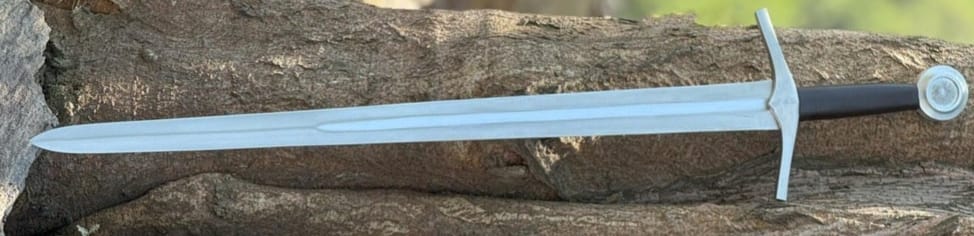
A Viking sword is broad and double edged because it was swung at an opponent behind a shield. A rapier is thin and stiff because it was carried in a city by a man who expected a duel, not a battle. A katana is curved because a curved edge slices as it passes. A gladius is short because a Roman soldier fought shoulder to shoulder in a line with no room to swing.
This guide covers the main types of swords, what each one was built to do, and what to look for if you are buying one for display, collecting or re-enactment.
Viking swords
The Viking sword is a broad, straight, double edged blade with a fuller running most of its length, a short straight crossguard and a heavy lobed pommel.
Every part of that has a reason. The blade is double edged because a cut that misses on the way out can land on the way back. The fuller, the groove down the centre, takes weight out of the middle of the blade without weakening the edges, which is what makes a blade this long controllable at arm's length. The pommel is heavy because it sits behind your hand as a counterweight, bringing the balance point back towards the grip.
Blade lengths usually run 28 to 32 inches, with a grip sized for one hand because the other hand held a shield.
A Viking sword was expensive in its own time. Most warriors carried a spear or an axe; a sword was a status object as much as a weapon, which is why so many surviving examples are decorated. That has not changed, and it is why most Viking swords sold today are bought for display and collections.
Arming swords
The arming sword is what the Viking sword became once armour improved.
It is still one handed and double edged, but the blade tapers more sharply to a point, because by the twelfth century an opponent was likely to be in mail and a cut that would open a tunic would not open rings. A taper gives you a point that can be driven between them.
The crossguard grew longer for the same reason: it protects the hand in a bind, when two blades are pressed against each other and someone is trying to slide down to your fingers.
Blade lengths sit around 30 to 32 inches. This is the sword most people picture when they hear the word knight.
Longswords
A longsword is a two handed sword that is still light enough to use in one.
The grip is long enough for both hands, usually 8 to 10 inches, and the blade runs 33 to 40 inches. That second hand is not there for strength. It is there for control: two hands on a long lever let you change the line of a blade mid-movement, which is most of what longsword fencing is.
They are lighter than people expect, usually 3 to 4 lb. A sword heavy enough to look impressive in a film would be unusable.
Many have a ricasso, an unsharpened section just above the guard, so the hand can be put over the crossguard for close work.
Katana and Japanese swords
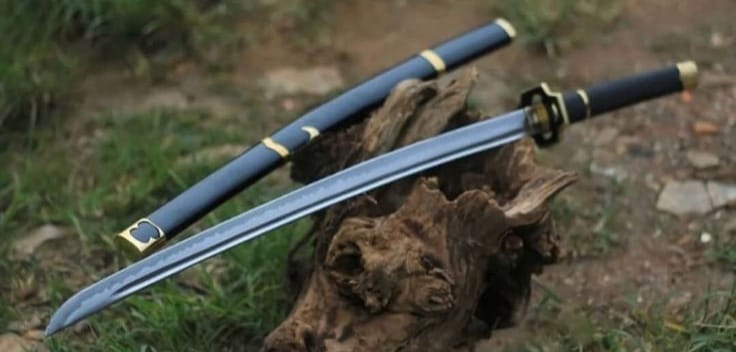
The katana is a single edged, curved blade, worn edge upwards so it can be drawn and cut in one movement.
The curve is the whole idea. A straight edge chops; a curved edge slides along the cut as it passes, so the same force cuts deeper. The blade is thick at the spine and thin at the edge, which is why a katana holds a very hard edge without the whole blade being brittle.
That hardness difference is made during heat treatment. Clay is laid thickly along the spine and thinly at the edge before quenching, so the edge cools fast and hardens while the spine cools slowly and stays tough. The visible wavy line between the two, called the hamon, is the boundary. On a genuine differentially hardened blade it is real. On most production swords it is etched or polished on.
Related shapes: the wakizashi is the shorter companion blade, around 12 to 24 inches; the tanto is the knife; the nodachi is the oversized field version.
If you are buying a katana for display, know that a folded-steel claim and a hamon claim are the two things most often exaggerated. Ask whether the hamon is from differential hardening or applied afterwards.
The gladius and short swords
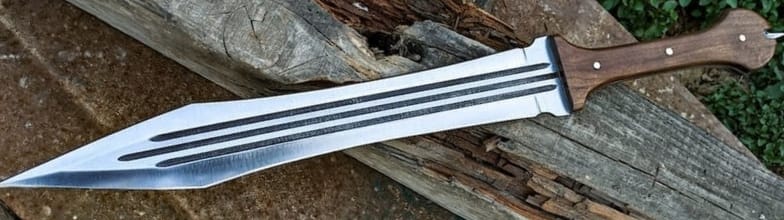
The gladius is short, straight and double edged, with a blade around 18 to 24 inches.
It is short because of how it was used. Roman infantry fought in a line, shoulder to shoulder behind large shields, with no room to swing. A short blade thrust forward past the edge of a shield is lethal and takes almost no space, and a line of men can all do it at once without hitting each other.
It is the clearest example in this guide of a weapon whose shape was decided by a formation rather than by a duel.
The seax, the Germanic and Anglo-Saxon short sword, is the single edged equivalent, sitting between a long knife and a sword and used as both.
Scabbards
The scabbard is half the object and usually gets a tenth of the attention.
A traditional scabbard is built around a wooden core, two shaped halves glued around the blade, then covered in leather. The wood holds the shape and protects the edge; the leather takes the wear. A scabbard that is just leather will let the blade cut its way out over time.
The metal fittings have names worth knowing: the throat is the collar at the mouth, the chape is the cap at the tip. On better pieces both are shaped to the scabbard rather than clamped on.
For a display sword a tooled leather scabbard is often the most decorated part of the whole thing, and it is where a maker's hand work shows most clearly.
A word on steel
A sword asks something of steel that a knife does not: it has to bend and come back.
A blade three feet long will flex in use, and one that cannot flex will take a set or snap. So sword steel is usually tempered softer than knife steel, trading a little edge hardness for toughness along the whole length.
1095 and other high carbon steels are the traditional choice. They are tough, they take a good edge, and they rust if left damp, which means oiling and drying.
Stainless steels such as 12Cr are common on display swords. They hold a bright finish for years with almost no care, which matters for a sword that will hang on a wall rather than live in a fitted scabbard. Be aware that stainless is generally not recommended for swords actually used for cutting practice, because it is less forgiving when flexed hard.
Damascus sword blades are forged from layered steel and carry the pattern through the metal. They need the same care as any high carbon blade.
H2 — Sharp or blunt?
This is a question worth asking before you buy, because the answer changes what the sword is for.
A sharpened sword is a cutting tool. If you plan to cut targets, you need one, and you need to know what you are doing.
A blunt or unsharpened sword is what re-enactment and stage work use, and it is also the safer choice for a piece that will be handled by visitors or hung where children reach.
A display sword is usually somewhere between: an edge that looks finished but is not taken to a shaving edge.
Check your local law. Many countries restrict carrying a sword in public regardless of whether it is sharp, and some restrict ownership of particular types. The rules nearly always concern carrying rather than owning, but they are worth reading before you order.
How to choose
Decide first whether this sword is going on a wall, into a collection, or into use.
For display and gifts, buy on looks and on the scabbard. A Viking sword with a tooled leather scabbard and a presentation box is doing its whole job the moment it is unwrapped.
For re-enactment, buy blunt, buy to whatever specification your group requires, and ask them before you order rather than after.
For cutting practice, buy from a maker who states the steel, the hardness and the heat treatment, and expect to pay for it.
For collecting a period, buy the shape that period actually used. A Viking sword and a longsword are four centuries apart, and nothing about one tells you about the other.